Journal
Architecture & Design
A Walk Down Kostava Street
Architecture & Design
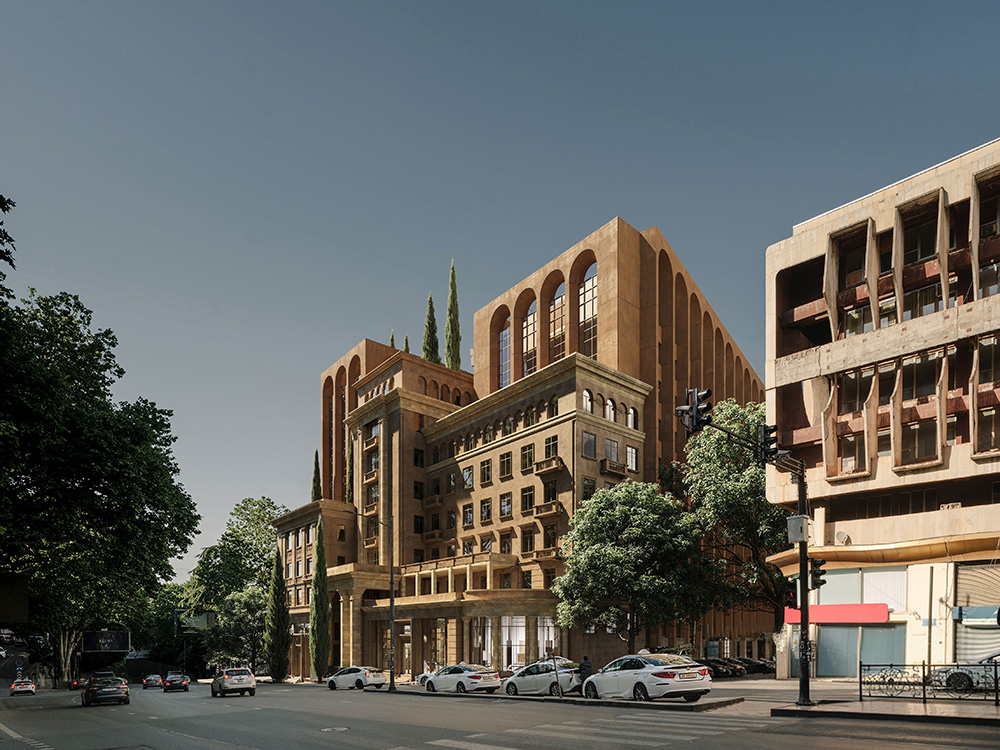
Immobiliare's first project sits on Kostava Street, one of Tbilisi's central historical addresses. Merab Kostava Street runs through the Mtatsminda District, from Shota Rustaveli Square at one end to Heroes' Square at the other. It is one of the city's main transport routes.
Throughout the Soviet period, the street was known as Lenin Street, and later Lenin Avenue. In 1989, it took its current name, after Merab Kostava, a Georgian dissident, musician, and one of the leaders of the national independence movement, who died that October.
Historic Buildings of Kostava Street
The dominant register on Kostava Street is late nineteenth and early twentieth-century construction. The style is eclectic, with elements of Art Nouveau, pseudo-classicism, and pseudo-Renaissance composed within the same blocks. Six of the buildings are registered as architectural monuments on this street. The area was once a suburb of Old Tbilisi known as Vardisubani. The city expanded outward from what is now Freedom Square toward Rustaveli Avenue, and the surrounding district took shape at the turn of the nineteenth century.
Kostava 12
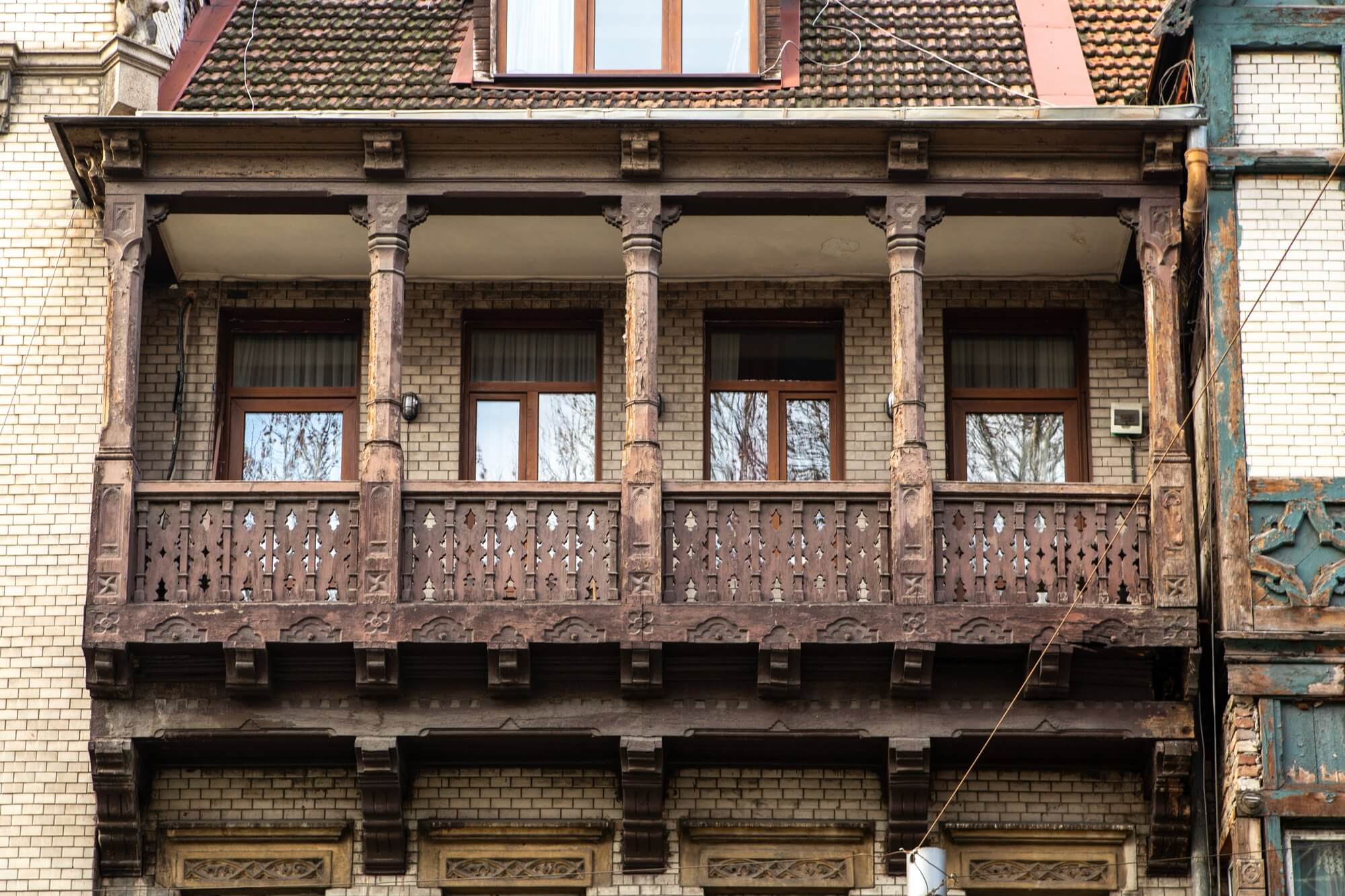
Built in 1910 by the Russian architect A. Ozerov, with plastic ornaments by the Tbilisi master Avetik Tshmaritian. The building was commissioned by Mikael Aramyants, a philanthropist and businessman, for Evgenia Shkhiants, the much younger woman he intended to marry. The arched passage of the 1970s reached this building, but the façade above it survived intact.
Stylistically, the composition is eclectic Art Nouveau drawing on Northern European motifs. White brick on the wall surfaces, a tower-like volume with a pyramidal hipped roof, a risalit imitating half-timbered construction, a wooden balcony, and an openwork iron balustrade. A small stone sculpture of a bear standing on its hind legs sits in the corner of the tower, visible only once you know to look for it.
Kostava 14
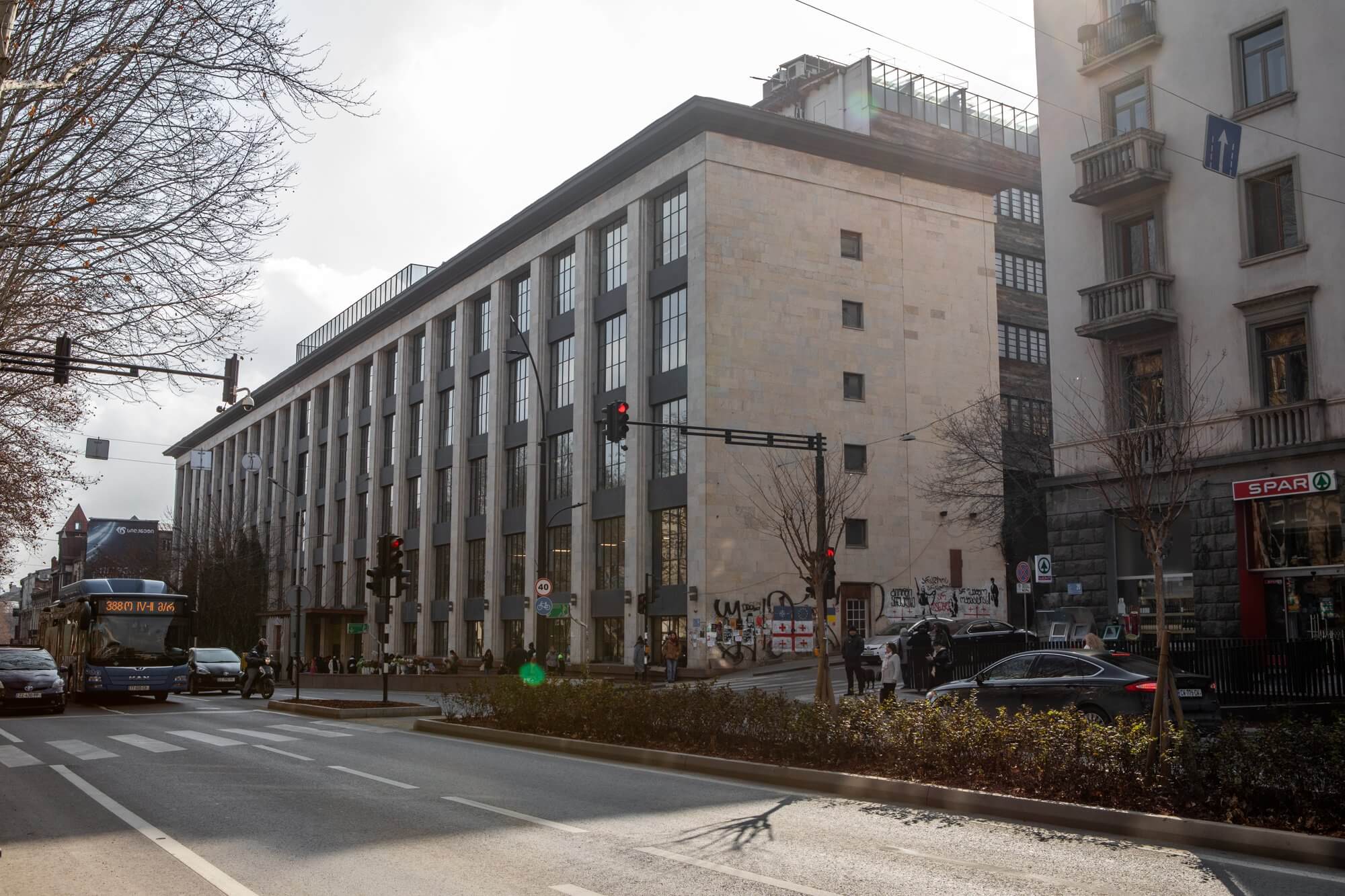
The building that occupies the entire block was built in 1961 by the architects David Moseshvili and Ilia Tarasashvili as a “Printing Plant”. During the Soviet period, it housed the editorial offices of the newspapers Komunisti and Samshoblo. The six-storey rectangular volume, with its even rhythm of wide openings and symmetrical organisation, is an example of Soviet modernist architecture working at an urban scale. The building today is the Stamba Hotel. The reconstruction kept the original façade in place and preserved the printing presses that remained inside.
Kostava 25
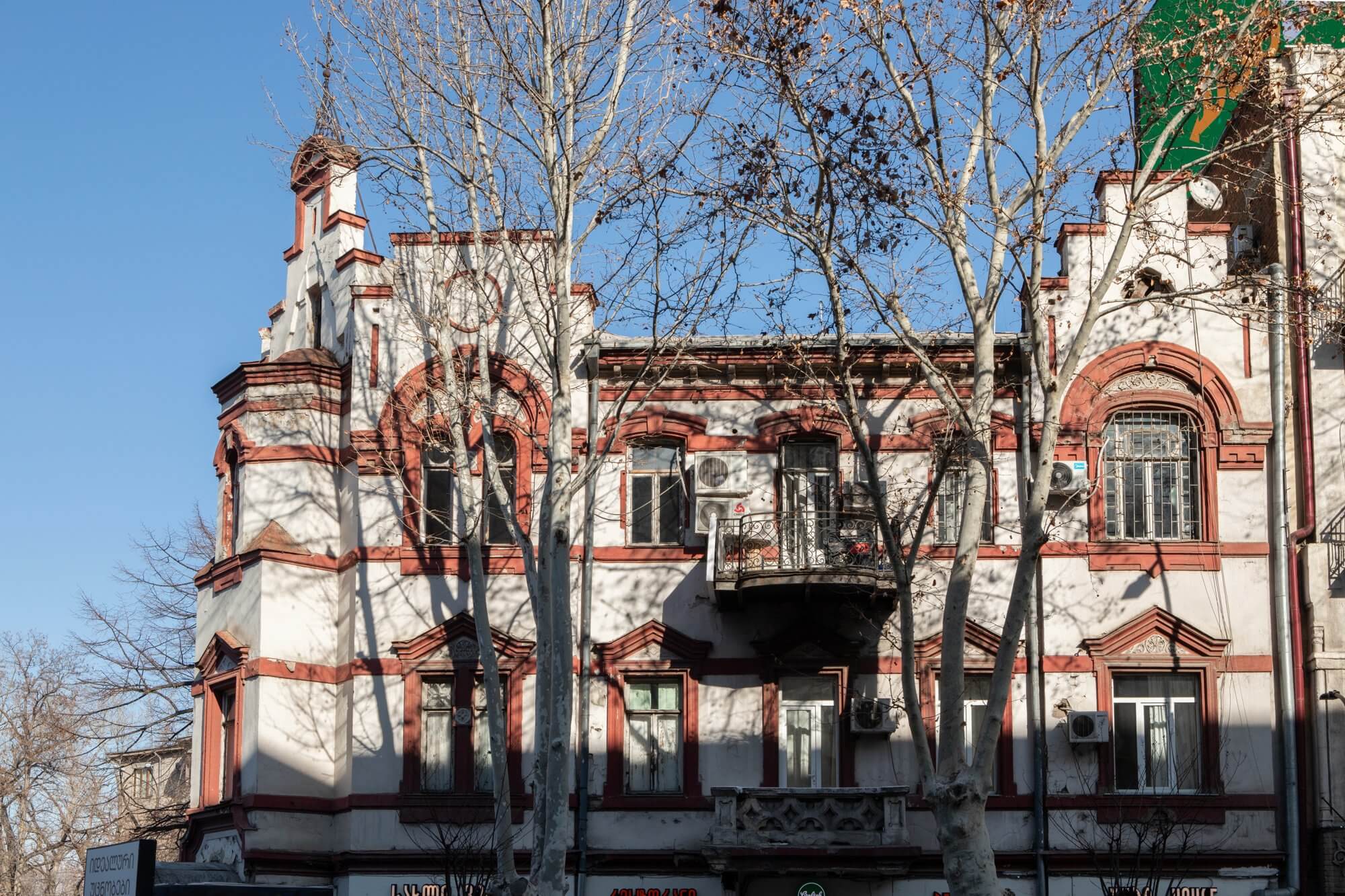
The residence of Aleksandre Sarajishvili, a Georgian critic, translator, journalist, and public figure, was built in 1905 by the Russian architect A. Ozerov. The building is three storeys, eclectic in style, with stylised elements drawn from both Renaissance and Gothic profiles.
A vertical bay window, paired arched windows under a single decorative arch, and a stepped parapet crowned with an openwork metal spire give the corner a closed, self-contained character. It is, in practice, the main façade of the building, and it acts as the architectural dominant of the development around it.
Kostava 38
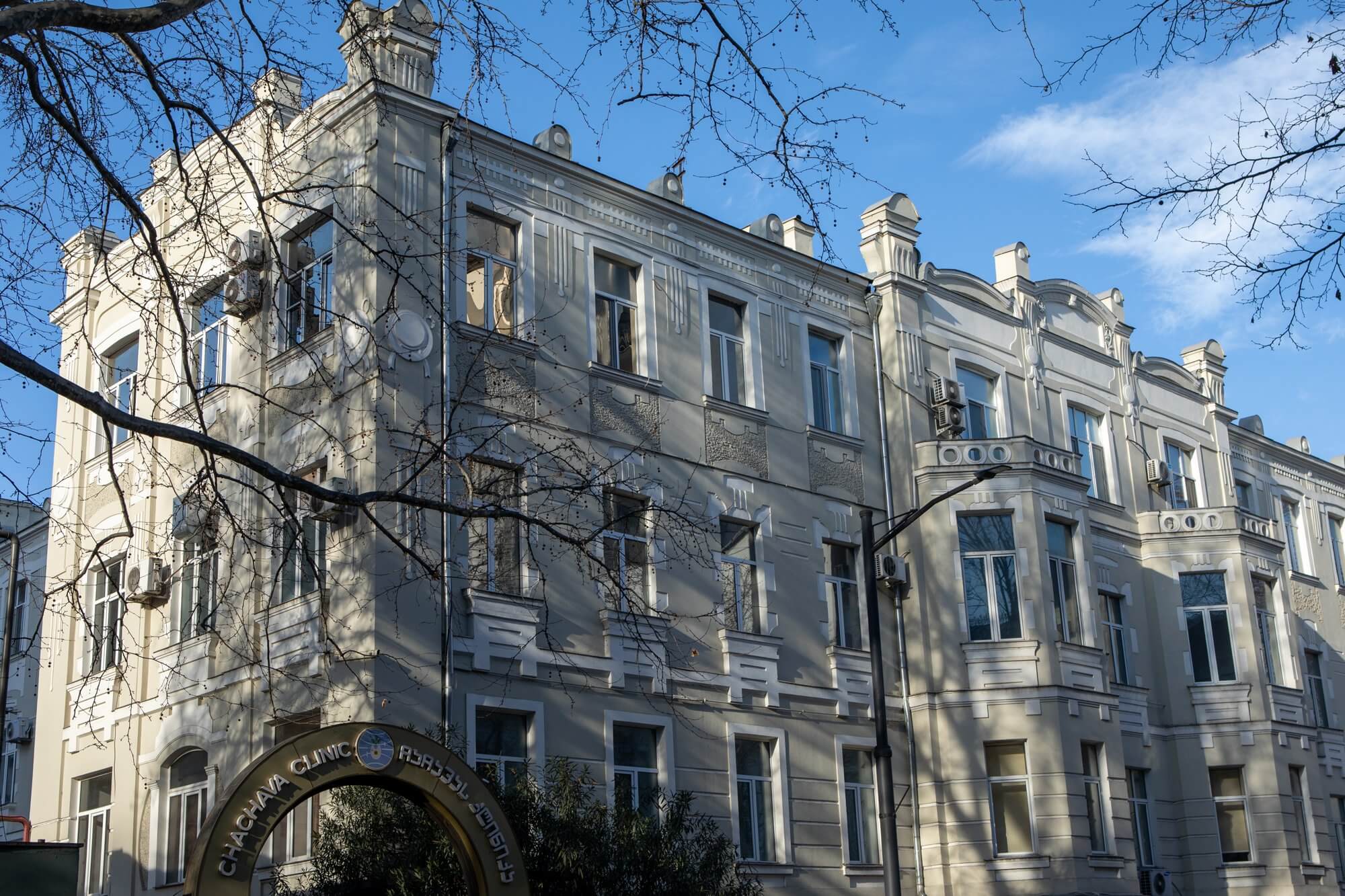
The Chachava Clinic was built in 1912 by the Polish architect Alexander Rogoyski, who worked in Tbilisi in the early twentieth century. The commission was for one of the oldest medical institutions in Georgia. A maternity hospital had been founded in Tbilisi in 1873, and in 1875 an obstetrics institute - the first in Transcaucasia was established on the same basis. Since 1912, the building has been the Scientific and Research Institute for the Protection of Mothers and Children. It remains in medical use. The four-storey façade follows the Art Nouveau fashion of the period, but with an unusually smooth plastic for the style. Rectangular doors and windows divide the wall in an even rhythm.
The Civic Fabric
The street carries a number of public sculptures. Muse, by the sculptor Merab Berdzenishvili with architect Ivane Chkhenkeli. Aspiration, by G. Tvrineli. A monument to Ekvtime Takaishvili. A bust of Merab Kostava by the sculptor K. Arunashvili with architect M. Iordanishvili.
The institutional fabric is dense. The former publishing house. The Chess Palace and the Alpine Club are set in Vera Park. The Amirani cinema. The Shota Rustaveli Institute of Georgian Literature. A cluster of medical institutes - Zhordania, Chachava, and Perinatal Medicine is concentrated in the same area. In 2007, a flower garden was created at the beginning of the street and the surrounding area was landscaped.
Inside the Neighbourhood
Kostava 49 is part of this neighbourhood. The buildings around it have stood for more than a century, and the institutions, parks, and transport links that residents use every day were in place before the project began. Rustaveli Square and its metro station sit at one end of the street, Heroes' Square at the other. Both are within walking distance. Vera Park, the Amirani cinema, and the Chess Palace are on the same street, and so is the cluster of medical institutes.
Kostava 49 is one of the street's historic buildings. Originally the Tea Administrative Building, it was commissioned by Georgia's Ministry of Food Industry and designed by Mikheil Neprintsev, a defining figure in Tbilisi's mid-century architectural landscape. It began as the headquarters for 97 tea factories and the agricultural land that supplied them, and later became the home of the Ministry of Food and Agriculture, a role it held until 2007.
The building is now recognised as a cultural heritage monument. Its form, materials, and proportions reflect the architectural ambitions of its period. After decades, it now takes on a residential role as Immobiliare's first project.
Bofill film title
Located outside Barcelona, an abandoned cement factory was transformed by preserving its industrial past. Original silos and concrete shells were repurposed into studios and offices, layered with lush gardens that soften the raw structure. This ongoing project treats architecture as a continuous evolution, where the factory’s past and modern life coexist in a living, breathing environment.