Journal
The Architecture of 1930s Tbilisi
The 19th and early 20th centuries reshaped Georgian architecture. Industrial growth and urban expansion accelerated the development of Tbilisi, and the arrival of Russian rule brought Empire-style formality into official construction - strict symmetry, colonnades, and measured proportions. As early as the 1920’s, the subject of the loss of the city’s original appearance was discussed not only by officials but also by artists. By the early 20th century, Art Nouveau and a "Pseudo-Georgian" style attempted to construct a national voice by applying medieval church carvings to modern facades. Soviet architects of the 1930s inherited this layered, uneven landscape and pushed for something more structural. The stated aim was architecture "Socialist in content, National in form."
The 1930s moved Tbilisi from eclectic toward a planned Soviet capital. Architecture was no longer about standalone buildings. It revolved around the General Plan (architects: I.Malozemov, Z. Kurdiani, G.Gogava; economist: S. Shelekhovski). The 1934 Master Plan widened embankments, reforested the Mtatsminda slopes, and laid out arterial roads, including Rustaveli and Chavchavadze. The decade established the administrative aesthetic of the city centre and introduced the first planned residential blocks, replacing the dense organic courtyards of earlier times.
The architects working at the time were faced with a city of contrasts. The outskirts lacked water supply, sewage, and greenery. Architecture became a tool for sanitation as much as for design. The Mtatsminda plateau was reforested to improve the local climate. Water networks expanded as a measure against epidemics. Resources were limited, so housing was nationalised and families were moved into existing apartments - a temporary response that eventually pushed architects toward residential blocks with integrated social facilities (nurseries, laundries, shared services).
The scale of the work produced a recognisable professional school. Nikoloz Severov, Kaspar Ter-Sarkisov, and Mikheil Neprintsev moved away from the fine-arts approach of the previous century toward a more technical discipline. Individual artistic design gave way to a collective method. Ter-Sarkisov, working closely with Neprintsev, introduced the principles of Rationalism to Tbilisi, an approach grounded in functional zoning and clear structural logic.
One of the most practical advances, however, was the apartment itself. Pre-revolutionary income houses often contained damp rooms facing sunless courtyards. The 1930s school established standards for insolation and ventilation. New dwellings were designed on a dual-ventilation principle - windows on at least two sides of a unit, allowing cross-breezes and direct sunlight. Architecture began to serve as a public health instrument rather than a decorative one.
Stylistically, the decade moved quickly. It opened under the influence of Constructivism, which prioritised structural truth: functional buildings with ribbon windows, flat roofs, and no applied ornament. By the late 1930s, the direction shifted toward Socialist Realism and Neoclassicism. Architects dropped the habit of attaching decorative motifs to facades and instead worked with local materials - yellow Bolnisi tuff among them, within classical proportions.
Kostava 49 and the Work of Mikheil Neprintsev
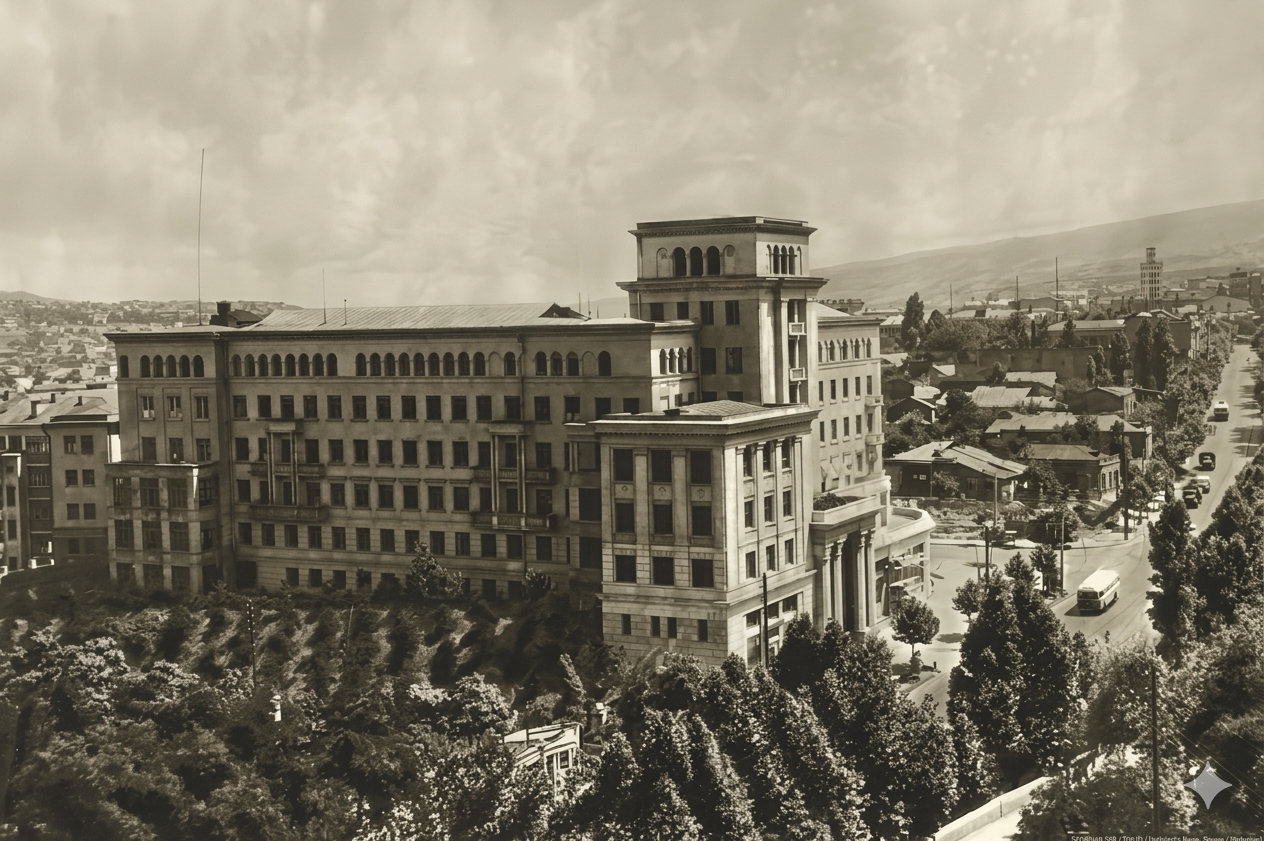
The Tea Administrative Building at Kostava 49, Immobiliare's debut project in Tbilisi, gives physical form to these shifts. It was originally designed as the headquarters of the state tea industry, which managed 97 factories. The primary facade is organised around multi-story columns topped with Corinthian-inspired capitals, a detail that connects Soviet monumentalism to older Mediterranean reference points. Deeply recessed arched windows introduce a quieter medieval Georgian motif. Inside and out, the project works on a consistent logic: heavy authoritative masonry set against the lighter rhythm of traditional Georgian carving.
Kostava 49 was designed by Mikheil Neprintsev, one of the defining architects of the period and among the few who worked credibly across three distinct waves: pre-revolutionary eclecticism, the 1920s avant-garde, and 1940s monumentalism. His projects remain part of the modern Tbilisi landscape.
Tbilisi Circus
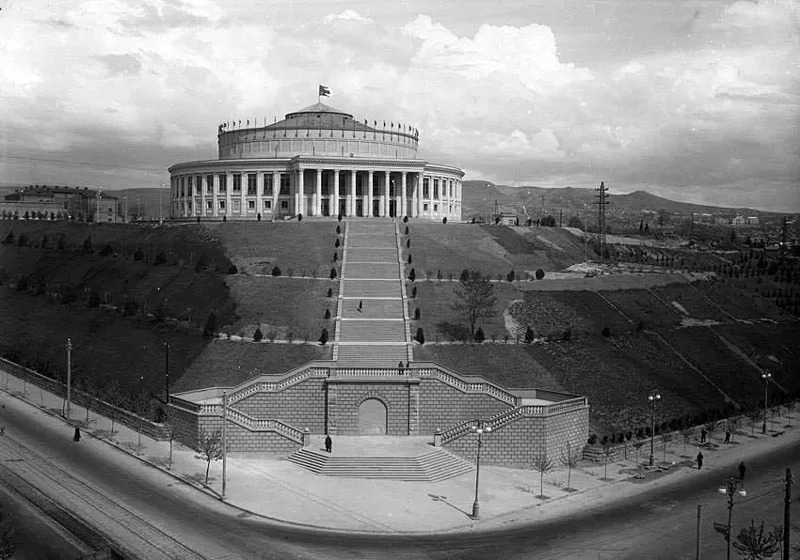
The Circus was the result of a 1935 competition that ended in compromise. Two sketches were merged into the final design - one by Neprintsev and S. Satunts, the other by V. Urushadze. Critics have noted that the synthesis produced a more modest building than either of the original entries, less pompous in its proportions but also stylistically uneven. The staircase and the main building belong to different architectural registers, and that mismatch shapes the character of the site.
The Circus sits on a 40-metre artificial hill overlooking Heroes Square. The staircase and the main entrance are deliberately not aligned on the same axis. Visitors approach at an angle, which allows the circular mass of the building to register as they move up the hill. The surrounding landscape has since grown dense enough to obscure much of the stone facade, but the structure remains a clear landmark of the period. Its circular form also became a reference point for later Soviet circuses, including the Ukrainian State Circus (1961), part of a wider standardised typology that was adapted locally across the USSR.
Georgian Technical University, Building I
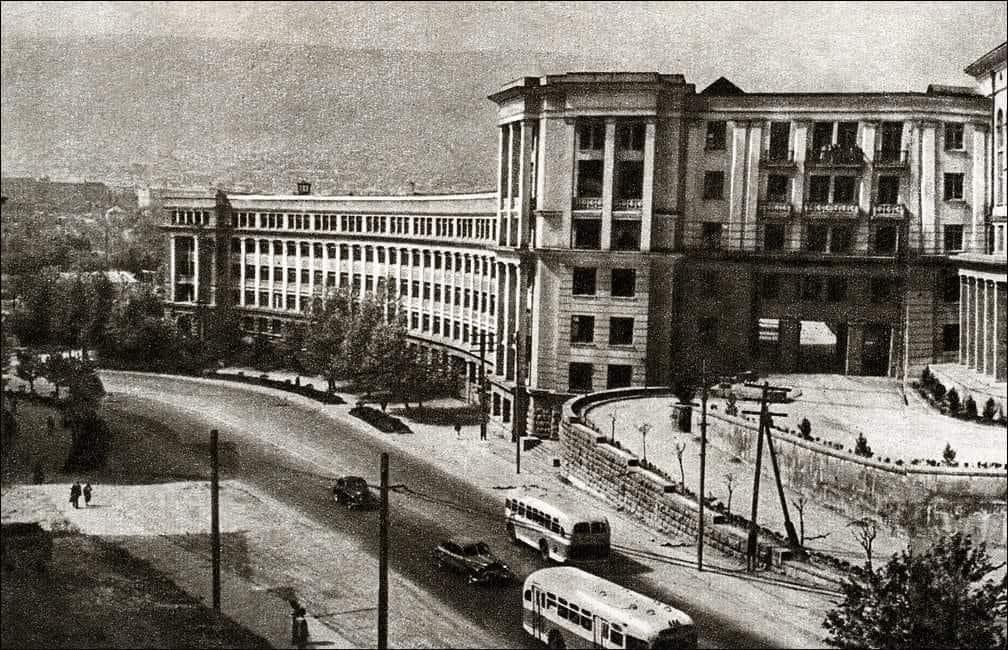
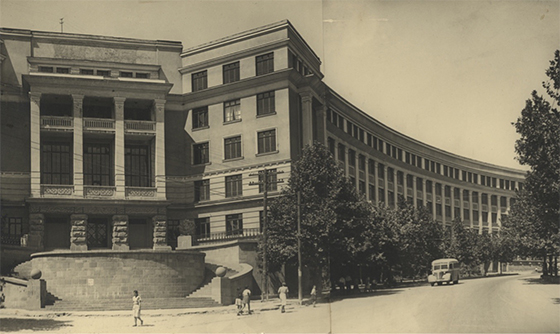
Among Neprintsev's larger projects is the Georgian Technical University Building. The project was completed and commissioned in 1954 alongside Glazkov. The building belongs to the Stalinist Neoclassical phase. Giant Corinthian pilasters give the facade its vertical emphasis, and the walls are clad in yellow Bolnisi tuff, the same material that runs through much of his work. Traditional Georgian carvings are integrated into the classical order rather than layered over it, placing the building within the same national-form approach that defined the decade. The level of detail reached beyond the building itself. The street lamps lining the perimeter were cast under Neprintsev and Glazkov's direct supervision. Neprintsev's connection to the institution was also academic. He taught at the Polytechnic Institute. The building still serves its original purpose to this day.
Georgian National Museum
Mikheil Neprintsev played a critical, often overlooked role in the project’s conception, long before the building found its definitive voice. The project originally broke ground in 1910 under architect Kornel Tatishchev with a design heavily influenced by "Moorish" and Islamic-inspired aesthetics, complete with pointed arches and minaret-like silhouettes. Neprintsev took over construction in the mid-1910s, but the geopolitical tremors of the First World War and the 1917 Revolution halted progress, leaving the building as a "black shell".
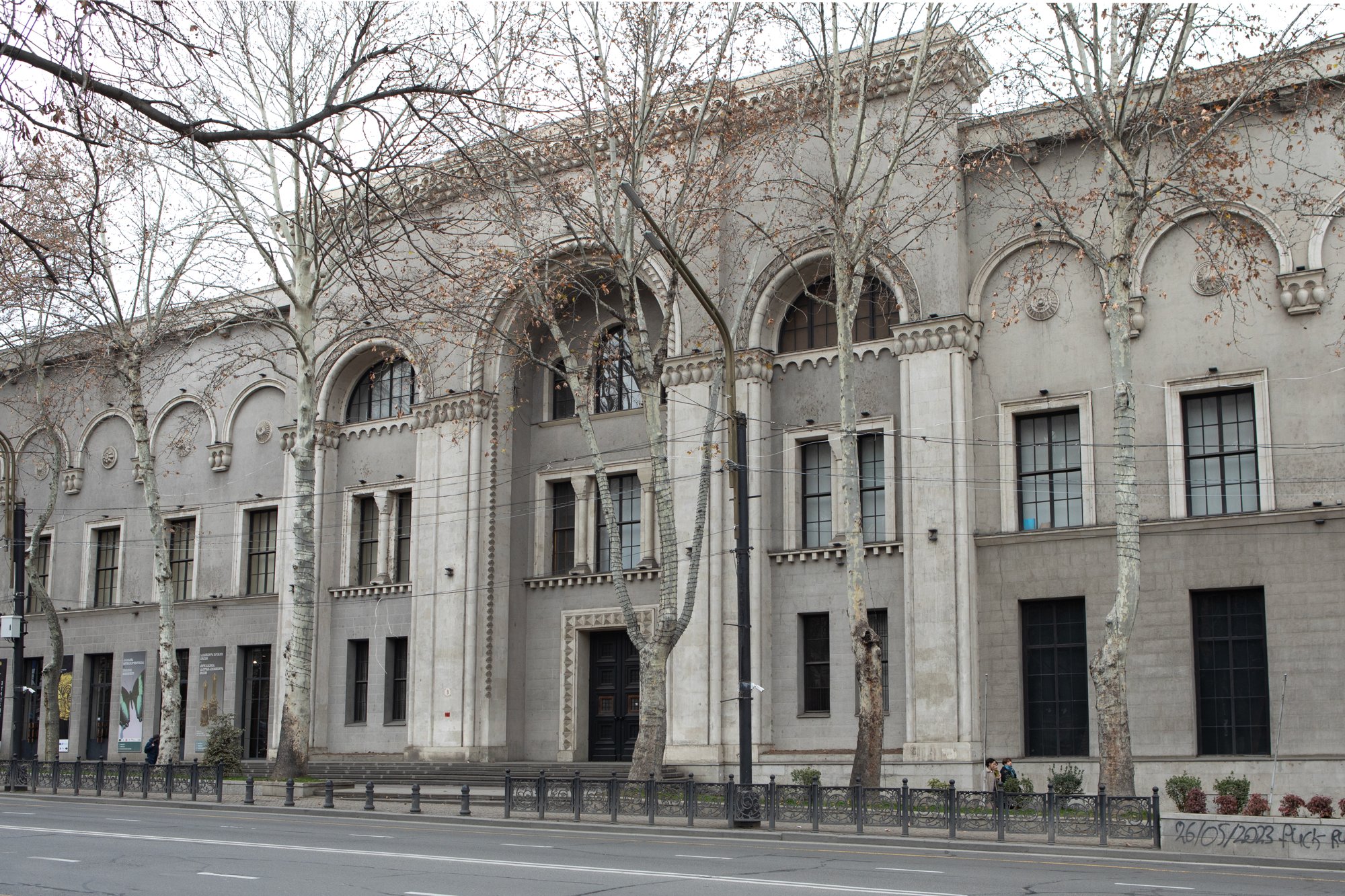
The completion of the museum between 1921 and 1929, under the leadership of Nikoloz Severov with Neprintsev’s collaboration, marked a decisive pivot in Georgian urban identity. The early "Moorish" aesthetic was abandoned. Rather than engaging in mere imitation of the past, the architects distilled the essence of medieval Georgian stone carving and integrated it into a massive, contemporary institutional frame.
What Remains
The 1930s left Tbilisi with a way of thinking about architecture as part of a larger system. Buildings were designed to serve a specific context, and that intent shaped their structure, materials, and proportions. Neighbourhoods have changed since, and many of these buildings will take on new purposes, but their original lives still define their identities. This is what makes Kostava 49 distinct. It carries its own history, and that history is still present in its walls.
Bofill film title
Located outside Barcelona, an abandoned cement factory was transformed by preserving its industrial past. Original silos and concrete shells were repurposed into studios and offices, layered with lush gardens that soften the raw structure. This ongoing project treats architecture as a continuous evolution, where the factory’s past and modern life coexist in a living, breathing environment.